




How to Read Betting Odds: A Simple Explanation That Actually Makes Sense
I remember staring at a betting slip for the first time and feeling like I was reading a foreign language. Numbers with slashes, numbers with decimal points, plus and minus signs everywhere. Nobody around me wanted to admit they didn't fully understand it either. So let me save you that awkward moment.
Betting odds tell you two things: how likely something is to happen (according to the bookmaker, anyway) and how much money you'll get back if you win. That's it. Everything else is just different ways of expressing those two pieces of information.
Fractional Odds — The British Classic
If you're betting in the UK, you'll see fractional odds everywhere. They look like this: 5/1, 3/2, 1/4. The number on the left is what you win, the number on the right is what you stake.
So 5/1 means for every pound you put down, you win five pounds profit. Stake a tenner, win fifty. Plus you get your tenner back. Total return: sixty quid.
3/2 means for every two pounds staked, you win three. Put down ten, win fifteen profit. Total return: twenty-five.
Now here's where it gets slightly confusing. 1/4 means you have to stake four pounds to win one. These are short odds — the bookmaker thinks this outcome is very likely. You'll see these on heavy favourites. The return is small because the risk is low. Well, supposedly low.
A quick way to figure out if the odds are good: if the left number is bigger than the right, you're looking at an underdog. If the right number is bigger, it's a favourite.
Decimal Odds — The One I Actually Prefer
Decimal odds are becoming more popular in the UK and they're standard across Europe. Personally, I find them much easier to work with.
The decimal number represents your total return for every pound staked. An odd of 3.00 means you get three pounds back for every pound bet. That includes your original stake, so the actual profit is two pounds per pound staked.
Here's the beauty of decimals: to calculate your return, just multiply your stake by the odds. Ten quid at 3.00 gives you thirty pounds total. No messing about with fractions.
Converting between the two is straightforward. Take fractional odds of 5/1: divide 5 by 1 and add 1. That gives you 6.00 in decimal. For 3/2: divide 3 by 2 (1.5) and add 1. That gives you 2.50.
American Odds — In Case You Ever Need Them
American odds use plus and minus signs. A plus number like +200 means that's how much profit you make on a hundred-dollar bet. A minus number like -150 means that's how much you need to bet to win a hundred dollars.
You won't see these much in the UK unless you're using an American platform, but it's worth knowing. The bigger the plus number, the bigger the underdog. The bigger the minus number, the stronger the favourite.
What the Bookmaker Doesn't Want You to Know
Here's the bit that matters most. The odds don't reflect the true probability of something happening. The bookmaker adds a margin — their built-in profit.
Take a coin flip. True probability is 50/50, which should give odds of 2.00 on each side. But a bookmaker will price it at something like 1.90 and 1.90. If you bet a pound on each side, you'd spend two pounds but only get back 1.90 regardless of the result. That ten pence difference, scaled across millions of bets, is how they make their money.
This margin varies between bookmakers, which is exactly why shopping around for the best odds matters. The difference between 2.10 and 2.00 on the same bet is significant over hundreds of wagers.
Implied Probability — The Hidden Maths
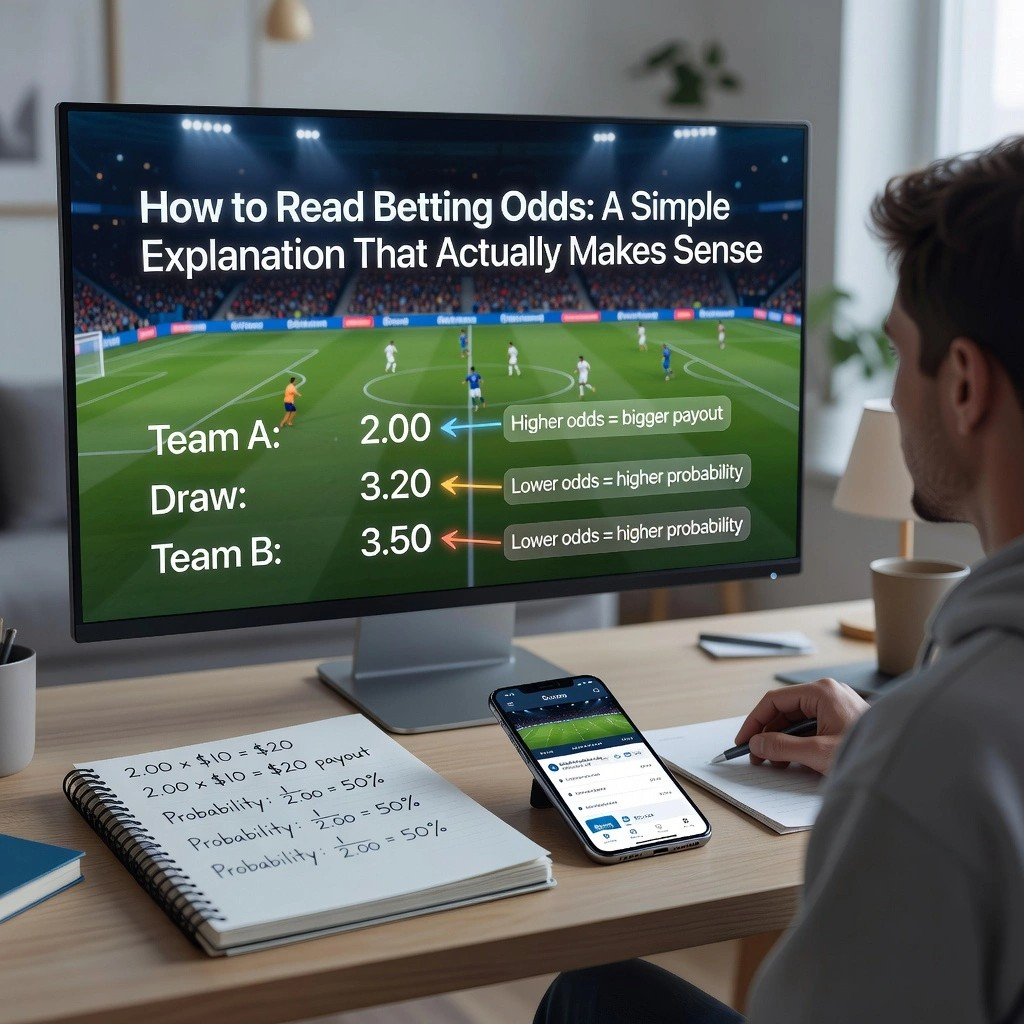
You can convert any odds into an implied probability. For decimal odds, divide 1 by the odds. So 2.00 implies a 50 percent chance. 4.00 implies 25 percent. 1.50 implies about 67 percent.
This is genuinely useful because it lets you compare what the bookmaker thinks will happen with what you think will happen. If you believe a team has a 50 percent chance of winning but the odds imply only 33 percent, that's potentially a value bet.
I say "potentially" because being right about probabilities is hard. Really hard. But at least understanding implied probability puts you on the right track.
Odds Movement — Why Prices Change
Odds aren't fixed until you place your bet. They move based on how much money is being wagered on each outcome. If thousands of people back one team, the bookmaker shortens those odds and pushes the other side out.
This movement can tell you things. A sudden shift in odds might indicate team news that hasn't been widely reported yet. Professional bettors — sharps — often bet early, and their money moves the market before the casual punters even notice.
Checking odds movement through a comparison site can give you insight into where the smart money is going. It's not foolproof, but it's another piece of the puzzle.
Putting It All Together
Next time you look at odds, try this: convert them to implied probability, compare that with your own assessment, and only bet when you genuinely believe the bookmaker has it wrong. That's value betting in a nutshell.
And remember — the bookmaker gets it right most of the time. They have entire teams of analysts and sophisticated models. But they don't get it right every time, and those gaps are where informed bettors find their edge.
Start by understanding what the numbers mean. Everything else builds from there.